Most dogs pull. That's not a training failure. It's not a personality problem. It's physics and instinct working exactly as designed.
Dogs move faster than humans. The outdoors is full of things that smell interesting, move quickly, and feel exciting. And when a dog pulls and gets closer to whatever caught its attention, that pulling worked. So it does it again. Behaviorists call this operant conditioning. The rest of us just call it Tuesday.
A study conducted in Ireland and the UK found that a reported 82.7% of pet dogs pull on leash. This isn't a niche problem. It's essentially the default state of dog walking, and it raises a question that doesn't get asked enough: when that pull happens, where does the force go? Coregulatedk9s
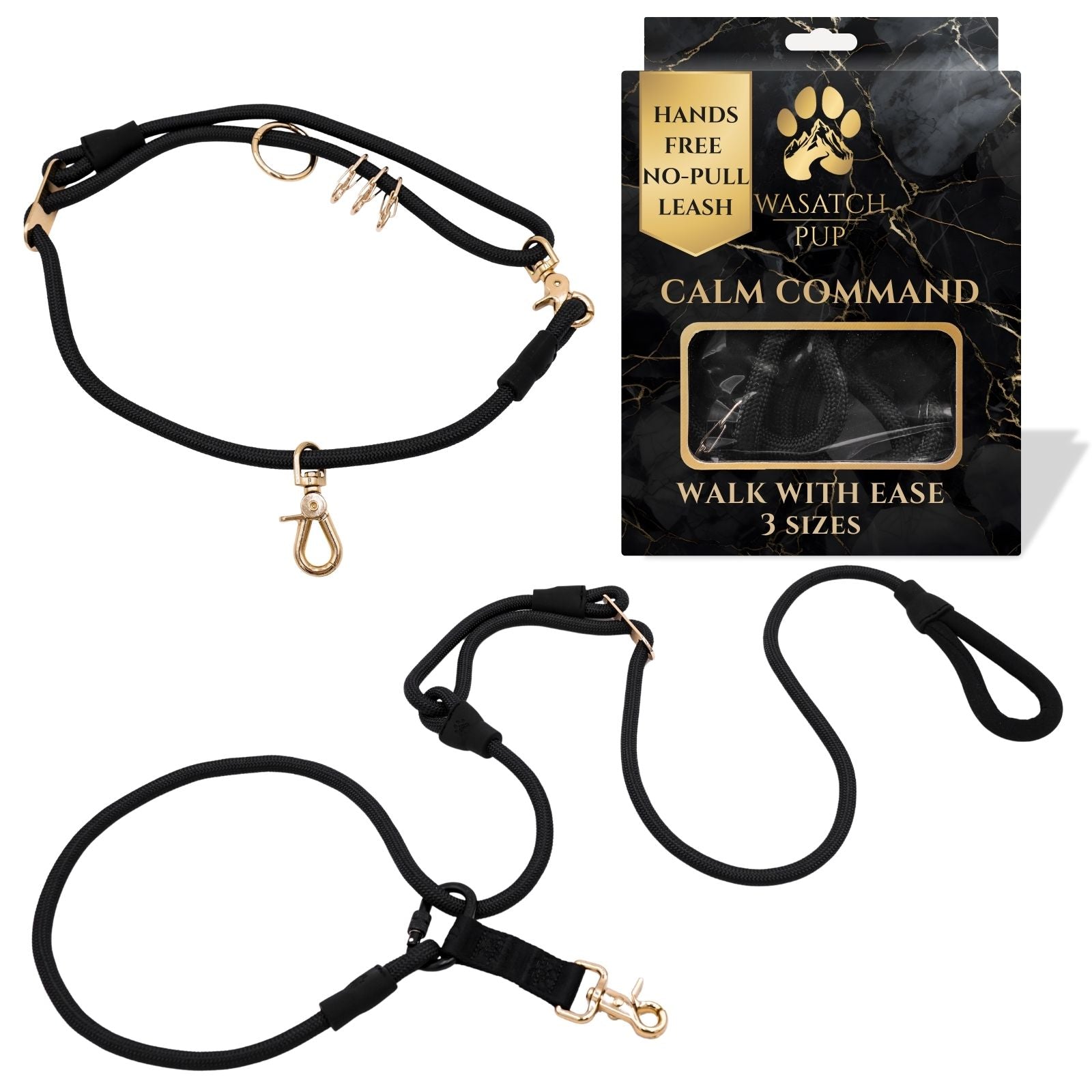
This article is about to the Calm Command Hands Free No-Pull Dog Leash by Wasatch Pup, click here for product details/additional context.
Every Leash Applies Pressure. The Question Is Where.
The moment a dog hits the end of a leash, force is generated. That force has to be absorbed somewhere on the dog's body. There is no version of leash walking where this doesn't happen. The only real variable is the location.
Traditional collars place that force directly on the neck. That's where the trachea lives. The cervical spine. The jugular veins. Nerves. Thyroid tissue. These are not structures that are built to absorb repeated compressive force, and the research on what happens when they do is not encouraging.

A peer-reviewed study published in the Journal of Veterinary Behavior tested seven collar types on a canine neck model and found that no single collar tested provided a pressure considered low enough to mitigate the risk of injury when pulling on the lead. The pressures recorded were significant. Contact pressure reached 4.58 N/cm², with maximal peak contact pressure at 44.61 N/cm². For reference, the lowest collar pressure value recorded in dogs was significantly higher than levels found to cause tissue damage and necrosis in humans. PubMed + 2
The nerve concern is just as real. Research suggests that just over 2g of weight can suppress a nerve's function by up to 50%, and the cervical and accessory spinal nerves run directly under the collar. PubMed Central
There's also the eye pressure issue, which most people have never considered. A 2006 study out of the University of Wisconsin-Madison evaluated 26 dogs and found that intraocular pressure increased significantly from baseline when pressure was applied via a collar, but not via a harness. The researchers specifically recommended that dogs with weak or thin corneas, glaucoma, or conditions for which an increase in intraocular pressure could be harmful should wear a harness instead of a collar, especially during exercise or activity. PubMedPubMed
None of this means every dog on a collar is being actively injured on every walk. It means the neck is the wrong place for repeated compressive force, and that the research supports being thoughtful about where leash pressure lands.
So Why Not Just Use a Harness?
Harnesses are a meaningful improvement over collars in terms of where pressure is applied. Most vets recommend them for pulling dogs, and that recommendation has a sound basis. But harnesses come with their own tradeoffs that are worth understanding honestly.
Standard back-clip harnesses allow dogs to lean into the pressure distributed across their chest and shoulders. The structure of the thoracic skeleton is likely more sturdy and less sensitive than the cervical skeleton of the neck, which allows dogs to pull more freely against a harness. In practice, many owners find that back-clip harnesses give their dog more pulling leverage, not less. ScienceDirect
 A 2023 study examining harness design and canine biomechanics found significant differences in stride length, body weight distribution between front and hind limbs, and apparent joint angles depending on which harness was worn. Fit and geometry matter. Not all harnesses are equal, and poorly fitted ones can affect how a dog moves. Taylor & Francis Online
Harnesses are also bulkier than leashes, require more time to put on and take off, and many owners find them impractical for everyday use. Many owners dislike using harnesses because they are cumbersome to put on the dog and should only be worn when the dog is walked outside. uspto
These aren't dealbreakers. Harnesses work well for a lot of dogs. But they're not a universal answer, and they don't close the conversation.
What Sled Dogs Can Teach Us About Pulling
Sled dogs provide a clear real-world example of how dogs use their bodies when pulling.
They are trained to generate forward force efficiently, and they do so using harness systems that distribute pressure across the chest and torso rather than the neck. This allows them to lean forward, engage their full body, and pull with strength and endurance.
This does not mean that everyday harnesses are designed for pulling in the same way. However, it does highlight an important mechanical principle:

When pressure is distributed across the body, dogs are physically able to push into it more effectively.
For working dogs, that is the goal.
For everyday walking, it helps explain why some dogs continue pulling even when using a harness. The pressure is distributed and more comfortable, but it can also allow dogs to maintain forward momentum rather than discourage it.
This is one of the tradeoffs worth understanding when choosing a leash system.
The Design Logic Behind Calm Command
The Calm Command leash starts from a straightforward mechanical principle: pressure equals force divided by area. The more surface area force is distributed across, the lower the intensity at any single point.

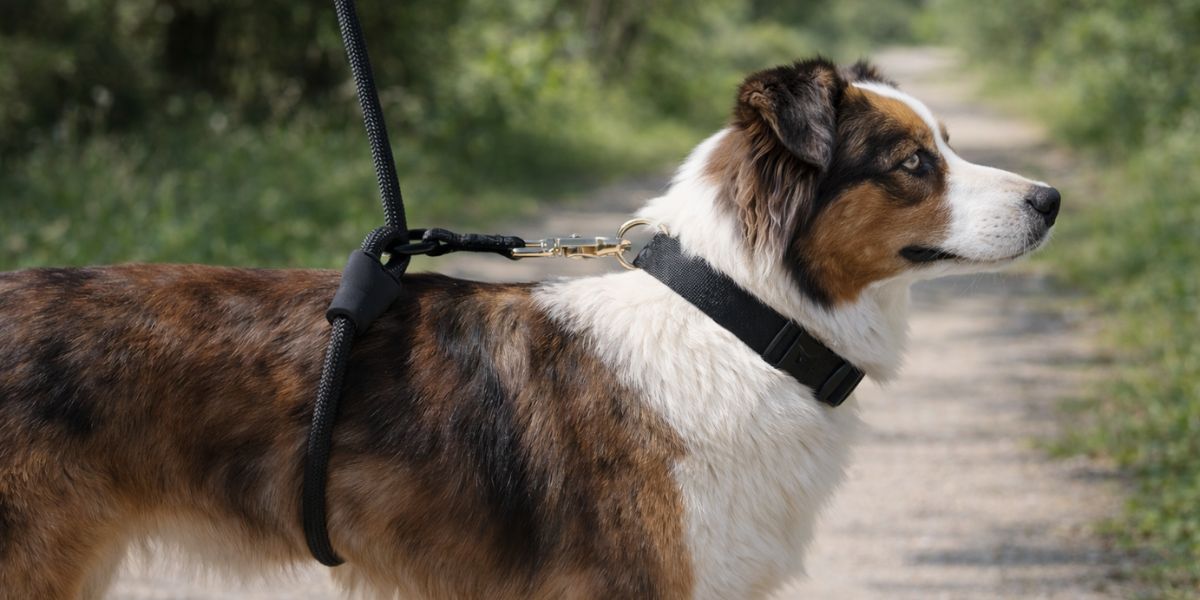
The leash loops around the dog's torso rather than concentrating force at the neck or relying on a chest attachment point. When the dog pulls, tension increases and the pressure is felt across a broader contact area. When the dog relaxes, tension drops and so does the pressure. The feedback is continuous and proportional to the dog's behavior rather than delivered as a sudden jerk or concentrated spike.
The torso is structurally suited to handle this kind of load in a way the neck simply isn't. The thoracic skeleton is denser. The tissue there is not wrapped around major blood vessels, the trachea, or spinal nerves. Force redistribution to sturdy body areas like the sternum rather than fragile joints and structures is a core principle of reducing injury risk in leash walking. FIDA Pet

This isn't a novel concept. Patent literature on body-wrap dog restraint systems consistently frames the principle the same way: by locating the leash connection in the middle of the dog's body, pulling forces are distributed and dissipated at the dog's torso in order to eliminate harmful forces at the neck, choking, and potential trachea injury. YAP USA
There's also a secondary effect worth noting. Because the feedback loop is immediate and tied directly to the dog's own behavior, the dog receives clearer information about what causes the pressure and what relieves it. Negative reinforcement through releasing gentle leash pressure when a dog moves into it rather than bracing against it is a recognized training approach, and a torso-wrap design supports that kind of feedback more naturally than a collar or back-clip harness. Coregulatedk9s
Let's Address any Objections Directly
"Isn't any pressure-based leash aversive?"
Every leash creates feedback. That's how leashes work. The more honest question is whether the feedback is proportional, where it's applied, and whether it creates a clear enough signal for the dog to understand. A tool that applies pressure across the torso with a consistent, proportional response to pulling is meaningfully different from one that concentrates force on the neck or delivers sharp corrections. The goal is not zero pressure. It's pressure that makes sense and lands somewhere appropriate.
"Why not just train loose leash walking without any tool?"
Training is important, and we’re not arguing otherwise. But leash pulling is one of the most common reasons owners struggle to maintain regular walks. In many cases, that leads to fewer walks overall, which can contribute to behavioral issues and, in more serious situations, rehoming or relinquishment. Real dog ownership is not perfect. It involves inconsistent schedules, reactive moments, and dogs at different stages of learning.
And to be frank, not everyone has the time to train consistently, not everyone has access to professional training, not everyone can afford it, and some people simply won’t follow through the way they intend to. That doesn’t mean those dogs should miss out on walks.
The Calm Command leash sits somewhere in the middle. It’s not just a standard no-pull leash, and it’s not a replacement for training. It functions as both a management tool and a training aid, helping make the walk more manageable while also providing consistent feedback the dog can learn from over time. A tool like this doesn’t replace training. It helps keep the walk happening while training continues. Coregulatedk9s
"My dog still pulls even in a body wrap."
Some will. No tool eliminates pulling in every dog in every situation. What changes is where the feedback goes, how the dog interprets the signal, and how much compressive force is landing on structures that weren't built for it. That matters even on walks where pulling still happens.
"Is this better than every harness for every dog?"
We can't say! Different dogs respond to different tools, and fit, body type, and individual temperament all factor in. What the Calm Command offers is no neck pressure, no bulky harness to wrestle onto the dog, and a proportional feedback mechanism tied to the dog's torso rather than a clip point. For a lot of dogs and owners, that combination works better than what they've tried before. It may not be the right fit for everyone, but we have seen great success with many dogs and believe strongly that this leash is a great solution!
Leash Safety
The Calm Command leash is designed to work with proper supervision and fit. Like any rope or leash-based tool, it requires responsible use.
Always supervise your dog while wearing the wraparound. Never leave your dog unattended in the leash, and keep it away from children and other unsupervised dogs to prevent accidental harm.
The wraparound does tighten when your dog pulls. Unlike some harnesses, it doesn't have a built-in stop point. This is intentional, as it creates the proportional feedback loop the leash is designed around. However, if your dog pulls excessively and the wraparound tightens too much for comfort, the leash may not be the right fit for that dog. Use your best judgment. In testing, we haven't seen this become a practical issue because most dogs quickly learn that pulling increases pressure and relaxing decreases it. Dogs are smarter about cause and effect than we often give them credit for.
Follow the fit and adjustment instructions included with the leash. Proper fit is essential for the leash to work as designed and to ensure your dog's safety and comfort.
The Bottom Line
Dogs pull because pulling works. Force has to go somewhere when it does. The neck is the worst place for it to land, and the research on collar pressure, nerve compression, tracheal risk, and even eye pressure makes that case clearly.
 The Calm Command leash was built on one idea: move that force somewhere better. The torso can handle load the neck cannot. Distributed pressure is less intense than concentrated pressure. Proportional feedback tied to the dog's own behavior is more legible than a sudden jerk.
That's the whole argument. It's grounded in physics, supported by veterinary research, and consistent with how responsible leash equipment should work.
- Carter et al. (2020). Canine collars: an investigation of collar type and the forces applied to a simulated neck model. Journal of Veterinary Behavior. PubMed
- Hunter et al. (2019). Pressure and force on the canine neck when exercised using a collar and leash. PeerJ. PMC
- Pauli et al. (2006). Effects of the application of neck pressure by a collar or harness on intraocular pressure in dogs. JAAHA. PubMed
- Bailey et al. (2025). Effect of a collar and harness on intraocular pressure and respiration rate of brachycephalic and dolichocephalic dogs. Veterinary Medicine and Science. PMC
- Kakinuma et al. (2024). An investigation of force potential against the companion dog neck associated with collar use. Journal of Veterinary Behavior. ScienceDirect
- Garfield et al. (2023). Effect of harness design on the biomechanics of domestic dogs. Journal of Veterinary Behavior. TandFOnline
- Townsend et al. (2022). Leash pulling prevalence, relinquishment correlation, and behavior outcomes. Referenced via CoreRegulatedK9s